A negative air machine is the most misunderstood piece of equipment on a mold job. Crews plug one in, watch the poly suck inward and call the area contained — without knowing the volume, the air changes or the actual delivered airflow. Here is what the machine does, how to size it, and how to prove it is doing the job. Every number below comes off the air changes per hour calculator, so run your own job through it as you read.
What does a negative air machine actually do?
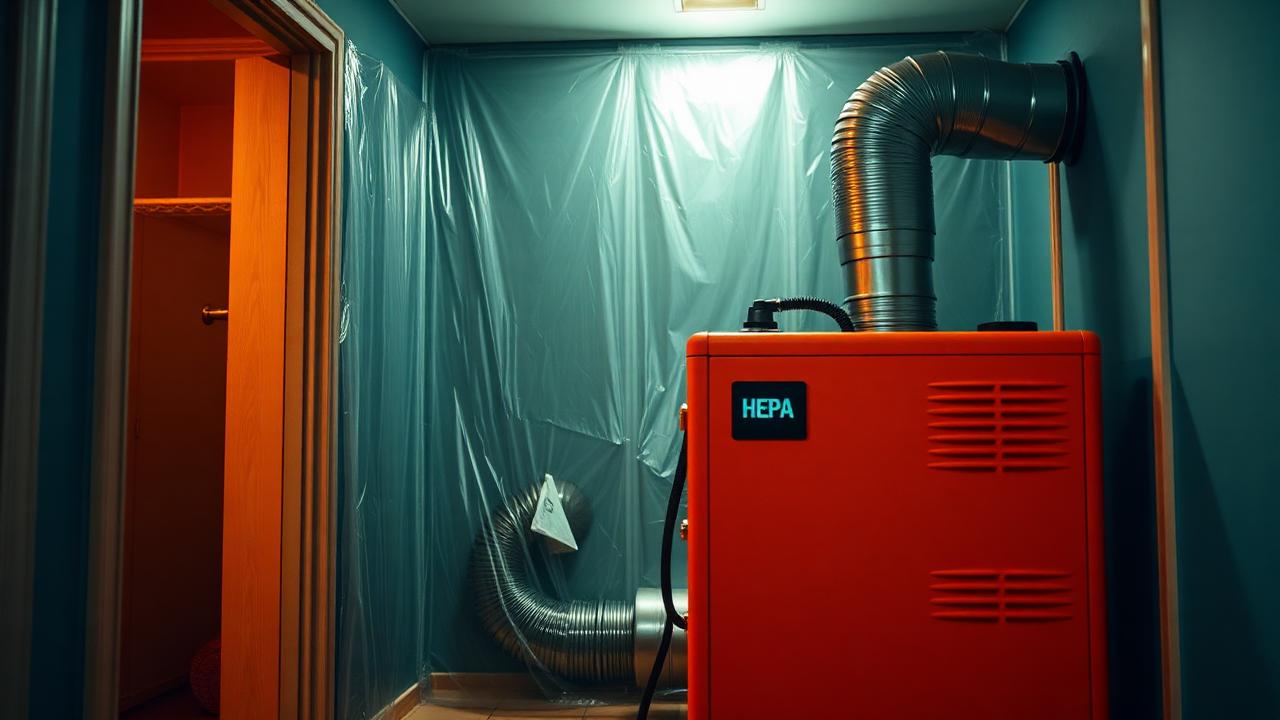
It does two jobs that people tend to conflate: it filters air, and it moves air out of the containment to create a pressure differential. Exhausted outside, it is a negative air machine; recirculating inside the space, the same box is an air scrubber.
The pressure job is what keeps leakage flowing inward at every gap. The filtration job is what reduces airborne particulate in the work area while you generate it. You need both on most Condition 3 jobs, and the setup decision — exhaust out or recirculate — decides which one you are getting.
What makes a filter HEPA?
A true HEPA filter is defined by an efficiency specification at the most-penetrating particle size, and it is a rated, tested component rather than a marketing word. “HEPA-type” and “HEPA-style” are not the same product and do not carry the same rating.
Just as important is what surrounds the filter. Air that bypasses a HEPA filter through a poor gasket or a warped housing is unfiltered air, so seating, gaskets and the machine’s condition matter as much as the filter’s rating. Run the pre-filters the manufacturer specifies and change them on schedule — pre-filters are cheap and they are what keeps the expensive filter breathing.
How do you calculate air changes per hour?
Air changes per hour is the machine’s airflow measured against the volume of the space: ACH equals CFM times 60, divided by the room volume in cubic feet. Turn it around when you are sizing equipment — required CFM equals volume times target ACH, divided by 60.
So the two numbers you need before you pick a machine are the volume of the containment (length times width times height) and the air changes you are targeting. The ACH calculator does both directions: enter the room and a target and it returns the CFM and machine count, or enter your machines and it returns the air changes you are actually achieving.
Irregular spaces get approximated — an attic by footprint times average height under the ridge, a crawlspace by footprint times clear height. Approximate high rather than low; you cannot get back airflow you did not bring.
Why is a machine’s rated CFM not the airflow you get?
Rated CFM is measured on a clean filter with no ducting. On a real job you have loaded pre-filters, twenty-five feet of lay-flat duct, a bend or two and a partially blocked intake, and delivered airflow drops accordingly.
That gap is why crews get poor results with equipment that should have been adequate on paper. Derate the machine when you size — the calculator has a field for it — keep duct runs short and straight, change filters before airflow visibly falls off, and check the machine’s own airflow indication if it has one. If the poly relaxes overnight, the filter is usually the reason.
Where should machines and ducting go?
Place the intake at the dirtiest end and exhaust from the far side so the air sweeps the space rather than short-circuiting. Exhaust to the exterior for negative pressure work, and route the duct so it does not discharge into another interior space, a soffit, or somebody’s open window.
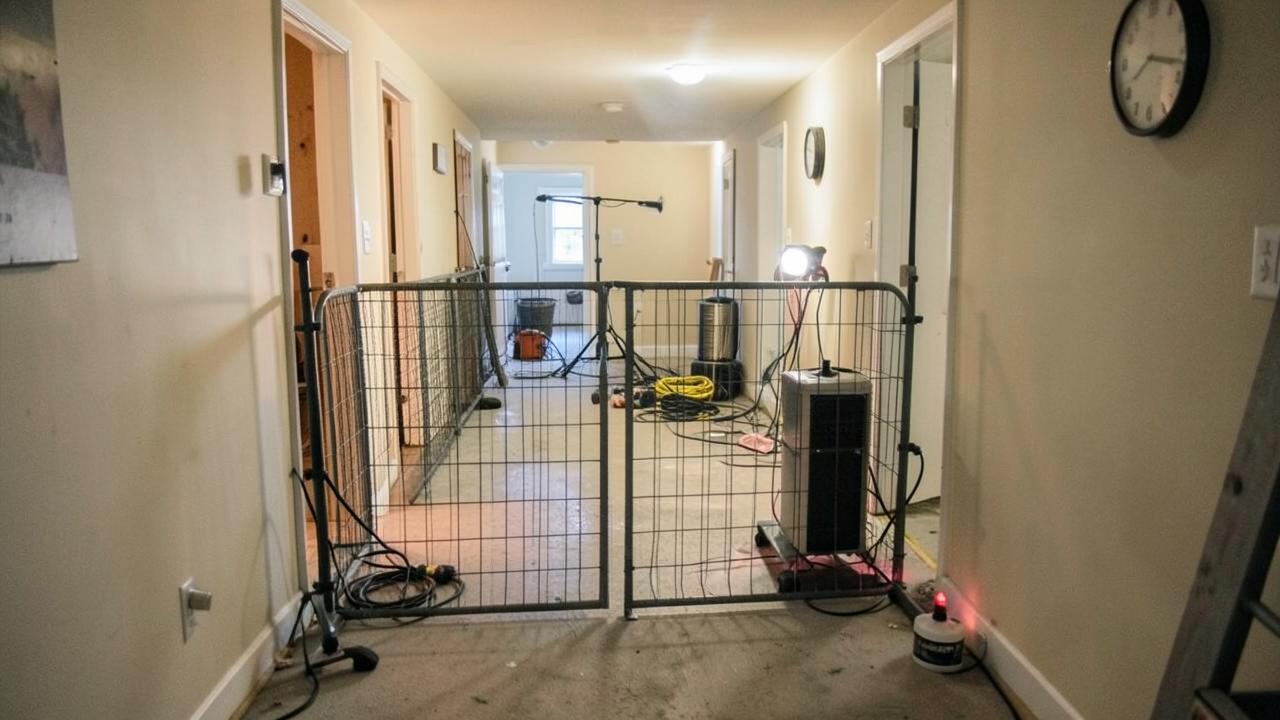
Other placement notes: keep the intake off the floor and away from a wall, avoid pointing a supply straight at a barrier, reposition partway through the job in a space with obstructions and dead zones, and seal the window or opening the duct passes through so you are not pulling straight back in what you just exhausted.
How do you prove the containment is negative?
Read the pressure differential with a manometer and log it, with the time. Visual cues — poly drawn in, door resistance, a smoke pencil at the seam — are useful confirmations and are not documentation.
Re-check after machine changes, filter changes, shift changes and anything an occupant did to a window or a door. The remediation checklist has the verification step in the site-setup section, and the reading belongs in your daily log alongside the moisture readings.
Do air scrubbers help after the work is finished?
Yes — running filtration after final cleaning and before verification is normal practice, because disturbance keeps particulate airborne for a while after the last tool goes down. Leave the machines running, containment up, and let the area settle before the IEP arrives.
What filtration will not do is substitute for cleaning. Air filtration reduces airborne particulate; it does not remove settled contamination from surfaces, and no amount of runtime turns an uncleaned room into a cleared one. Post-remediation verification looks at surfaces first — see post-remediation verification.
How do air filtration costs get estimated?
Estimate equipment by machine count and days on site, plus filters and setup labour, and let the machine count come from the volume rather than from what is on the truck. Sizing first, pricing second, keeps the estimate defensible.
Take the machine count off the ACH calculator and the pricing off the cost calculator with your own rates loaded. Where containment and filtration are both in play, the containment types guide covers the barrier side of the same setup.
What is the difference between a negative air machine and an air scrubber?
It is the same equipment used two different ways. Ducted to the exterior it exhausts air out of the containment and creates negative pressure; running inside the space with no exhaust duct it filters and recirculates, reducing airborne particulate without changing the pressure.
Knowing which one you have set up matters, because a machine recirculating inside a containment is not providing any pressure differential at all - regardless of how well it filters. On many jobs you want both: one machine ducted out for pressure control, another recirculating to increase the filtration rate in the room. The calculator handles them the same way for air-change purposes; the difference is what the exhaust is doing.
How do you maintain machines so they keep performing?
Change filters on condition, not on habit, and keep the machine clean. Airflow falls off gradually as pre-filters load, and nobody notices until the containment stops holding negative pressure.
- Check pre-filters daily on a running job and change them when loaded.
- Replace the HEPA element per the manufacturer's guidance and when airflow indication says so.
- Inspect gaskets and the filter seating; bypass around a good filter is unfiltered air.
- Decontaminate the machine housing before it leaves the containment.
- Keep ducting undamaged - a torn lay-flat duct in an occupied hallway is a contamination event.
- Log which machines ran where and for how long, for the job file.
Filter changes happen inside the containment, in PPE, with the old filter bagged before it leaves. Treat a loaded HEPA filter as contaminated waste, because that is what it is.
What does the AMRT exam ask about air filtration?
Expect the ACH relationship in both directions, the difference between an air scrubber and a negative air machine, what HEPA means, and why filtration is not a substitute for cleaning or for source correction. Scenario questions usually hand you a room and a target and want the equipment decision.
Practise until the arithmetic is automatic — free practice questions and the AMRT flashcards both cover it, and the AMRT certification guide explains the exam format.